Learn
Why AI work needs a durable command center
AI can accelerate work without giving that work a dependable home. A durable command center keeps the mission, current truth, artifacts, evidence, ownership, and final calls aligned—even when execution happens elsewhere.
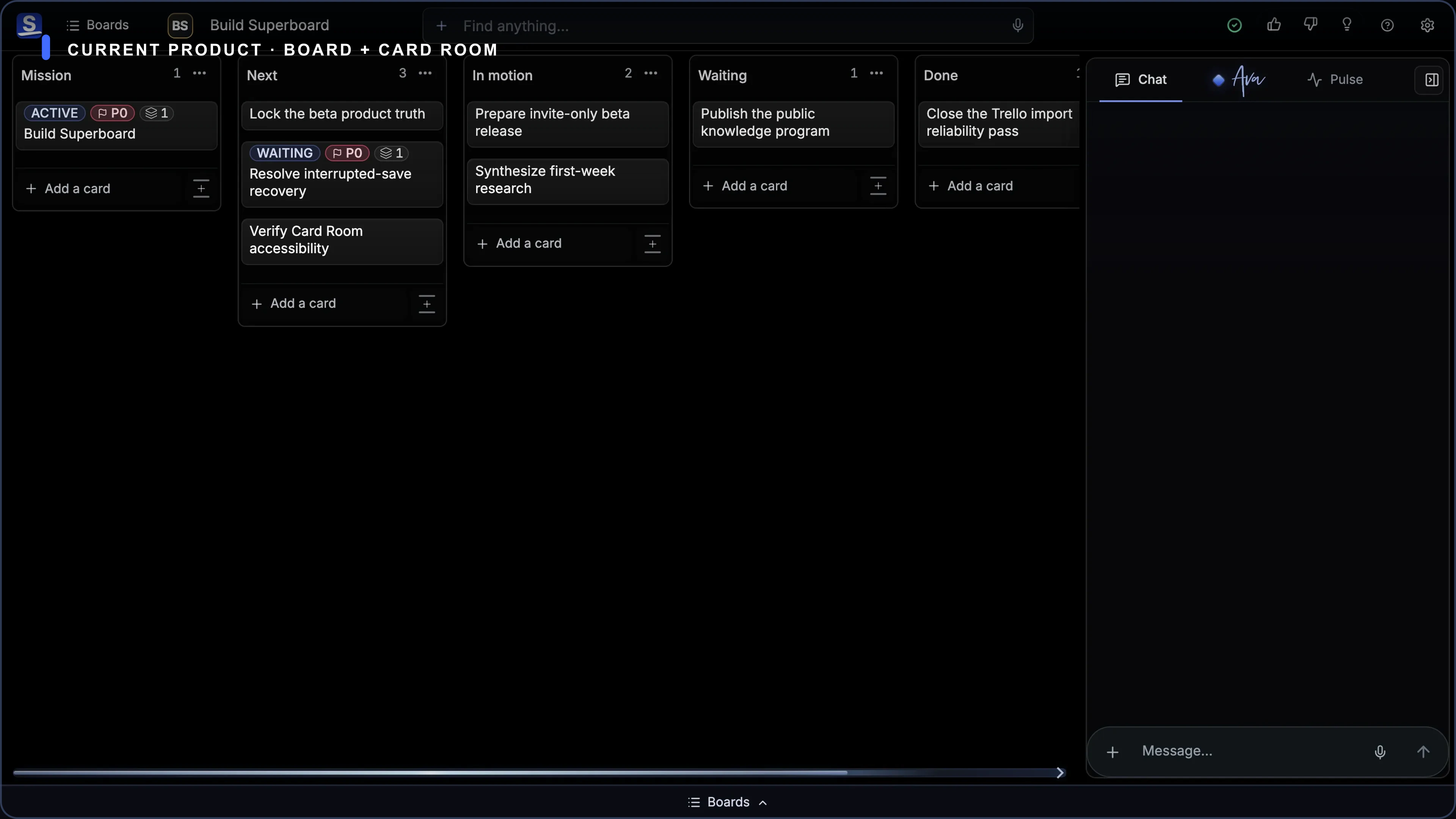
AI conversations and agent runs multiply output—and coordination cost.
The Card remains the canonical home when work happens in another tool.
Current Superboard preserves bounded work today; multi-agent coordination remains Direction.
Chat threads fragment the mission
Separate conversations create separate versions of context. One agent changes the plan, another drafts from an older assumption, and a third creates an artifact no one can find. The human becomes the copy-and-paste integration layer.
A command center gives work stable identity. The Card explains the assignment. Its Room holds the current artifacts and conversation. The Board shows how that item relates to the rest of the mission.
The Card remains the canonical home
A coding environment, model chat, research tool, or connector may be the best place to perform part of the work. It is not automatically the best place to preserve the assignment, accepted artifact, decision, and history for the whole mission.
In Superboard’s operating model, the relevant Card remains canonical. Its Room holds the accepted work and rationale; the external environment remains a supporting tool. That rule prevents a successful run from becoming an orphaned result.
Available today
Available today: durable structure around bounded AI work
One signed-in Owner can organize a mission in cloud Boards, Cards, and Rooms; keep Stage artifacts and sequential Chat together; inspect Pulse and Activity; recover supported changes; and invoke Ava explicitly with @Ava in Card Chat when live AI is configured.
Ava’s current foundation is bounded. Superboard does not yet provide production multi-agent coordination, a unified Guide/Board runtime, broad external execution, or Cloud Ava that continues general work while the laptop is closed.
What the shared system must preserve
- The goal, constraints, and current priorities.
- Who or what owns each piece of work.
- The current artifact instead of competing copies.
- Decisions that need human judgment or approval.
- Provenance: what changed, why, by whom, and whether it can be reversed.
What remains with the Owner
Superboard—not the Owner acting as a copy-and-paste clerk—keeps the current artifact, conversation, attribution, and history together. The Owner remains responsible for the mission’s purpose and constraints, exercises consequential judgment, and makes or approves the final calls that require human authority. Ava can prepare and coordinate supported work, but she does not inherit those decisions or that authority.
Direction
Direction: one point of contact
Superboard’s direction is not a dashboard where the Owner manages 30 AI workers one by one. Ava would represent and coordinate the specialist workforce, synthesize ordinary work, rank important decisions, and escalate only where human judgment is valuable.
A unified cross-Board decision queue and complete multi-agent coordination are not currently shipped. The destination remains one Ava and one product relationship, not a visible roster of bots for the Owner to manage.