Example
How Superboard is built in Superboard
Superboard is used to build Superboard. The public example preserves the real operating pattern—one Board, flexible Cards, durable Rooms, current state, and attributed history—without exposing the Founder’s private production data.
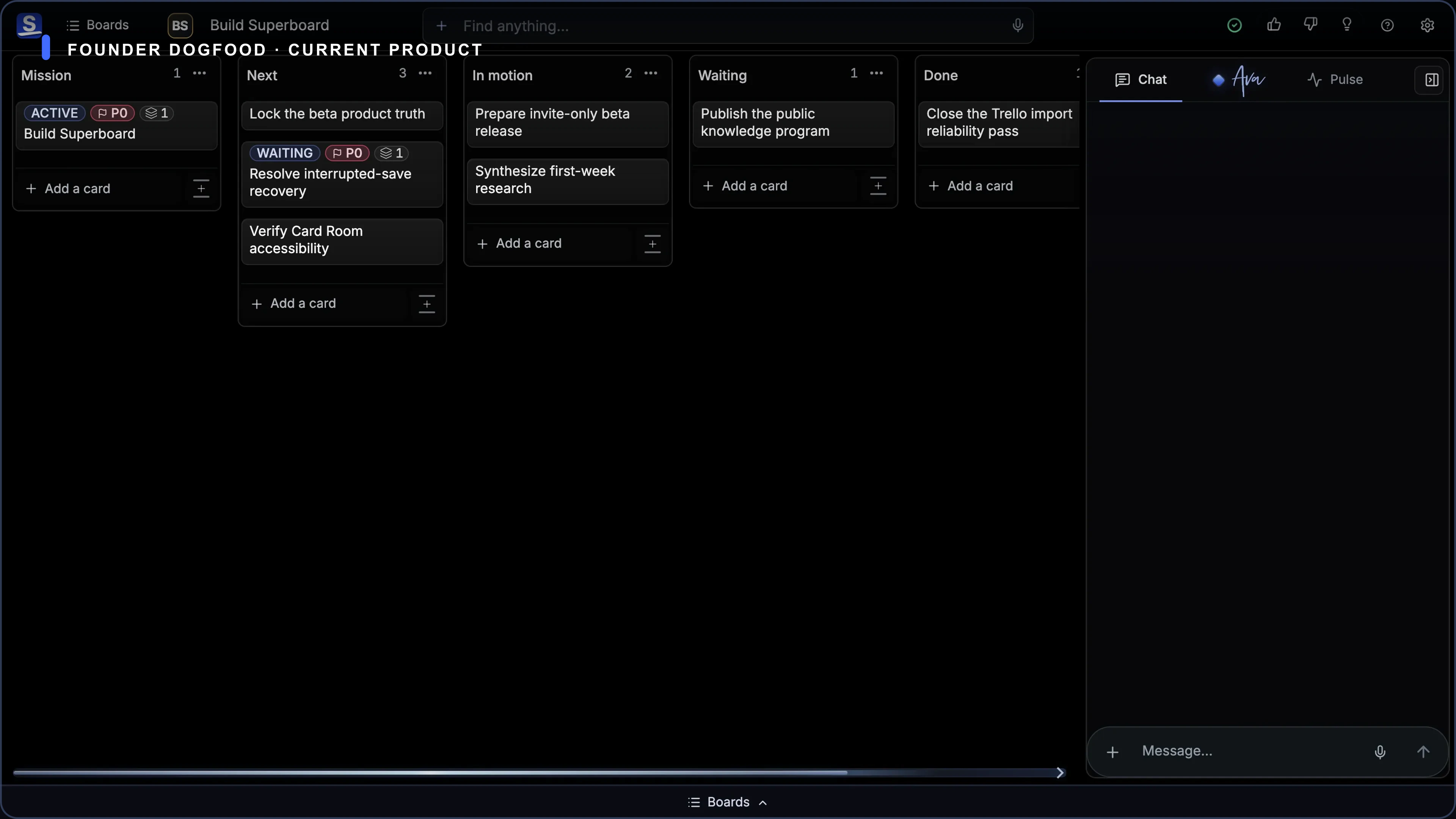
One Board makes the mission visible as one operating picture: build the clearest, most dependable home for human and ai work.
Cards are flexible work atoms; each opens into a Room with Stage, Chat, Pulse, and Activity.
The captured interface and explicit @Ava requests are current; broader preparation and external execution are Direction, while the Owner keeps the mission, its constraints, every consequential judgment, and real authority.
Available today
Available today: one Board for the mission
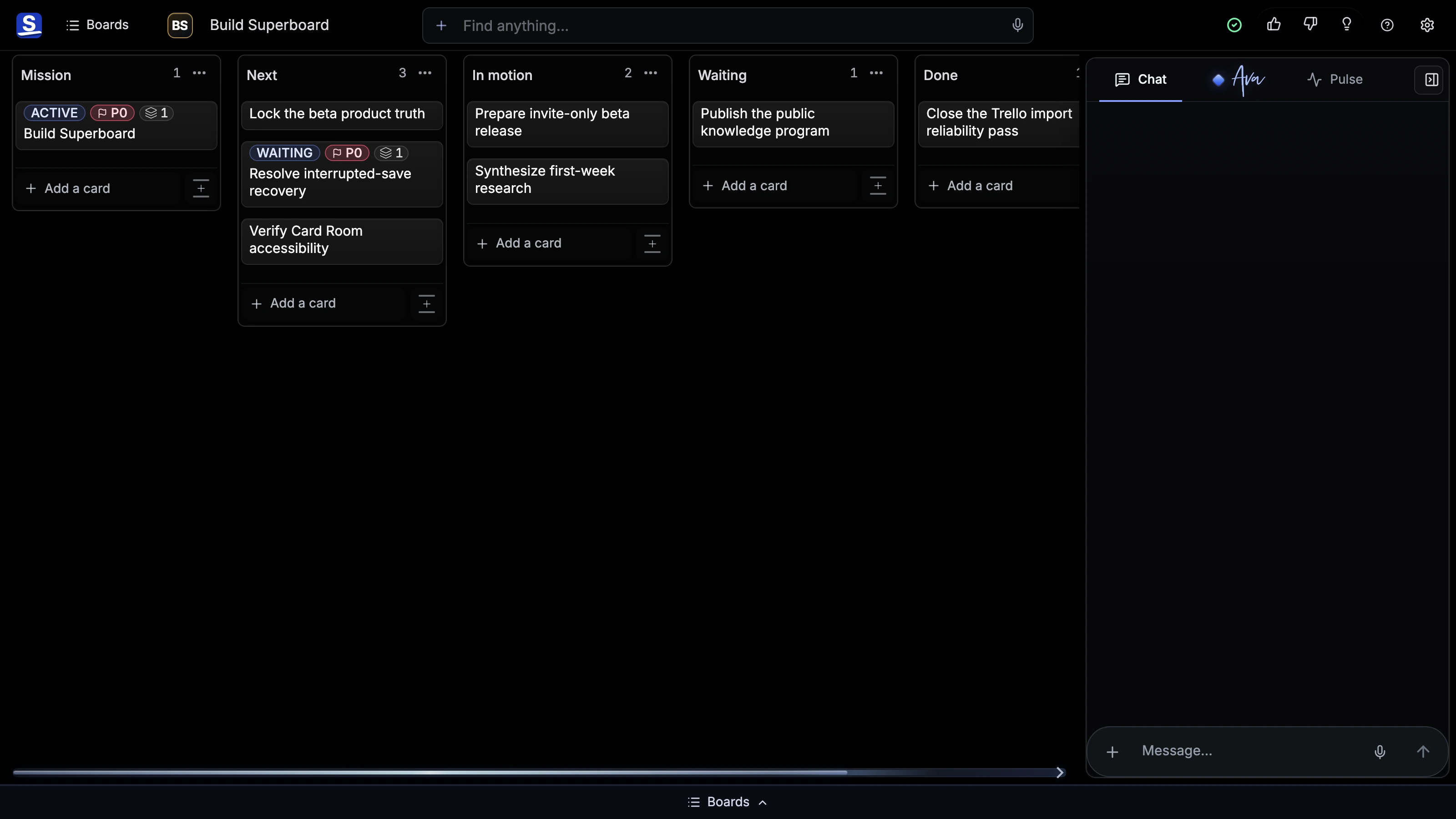
The mission is to build the clearest, most dependable home for human and AI work. The deterministic example uses Lists for Mission, Next, In motion, Waiting, and Done so the current front remains scannable.
Cards represent specifications, product decisions, defects, research, releases, and public content—not merely tasks. Current Superboard can hold these different forms of work without forcing them into one task-only schema.
Available today
Available today: the Room keeps the work and reasoning together
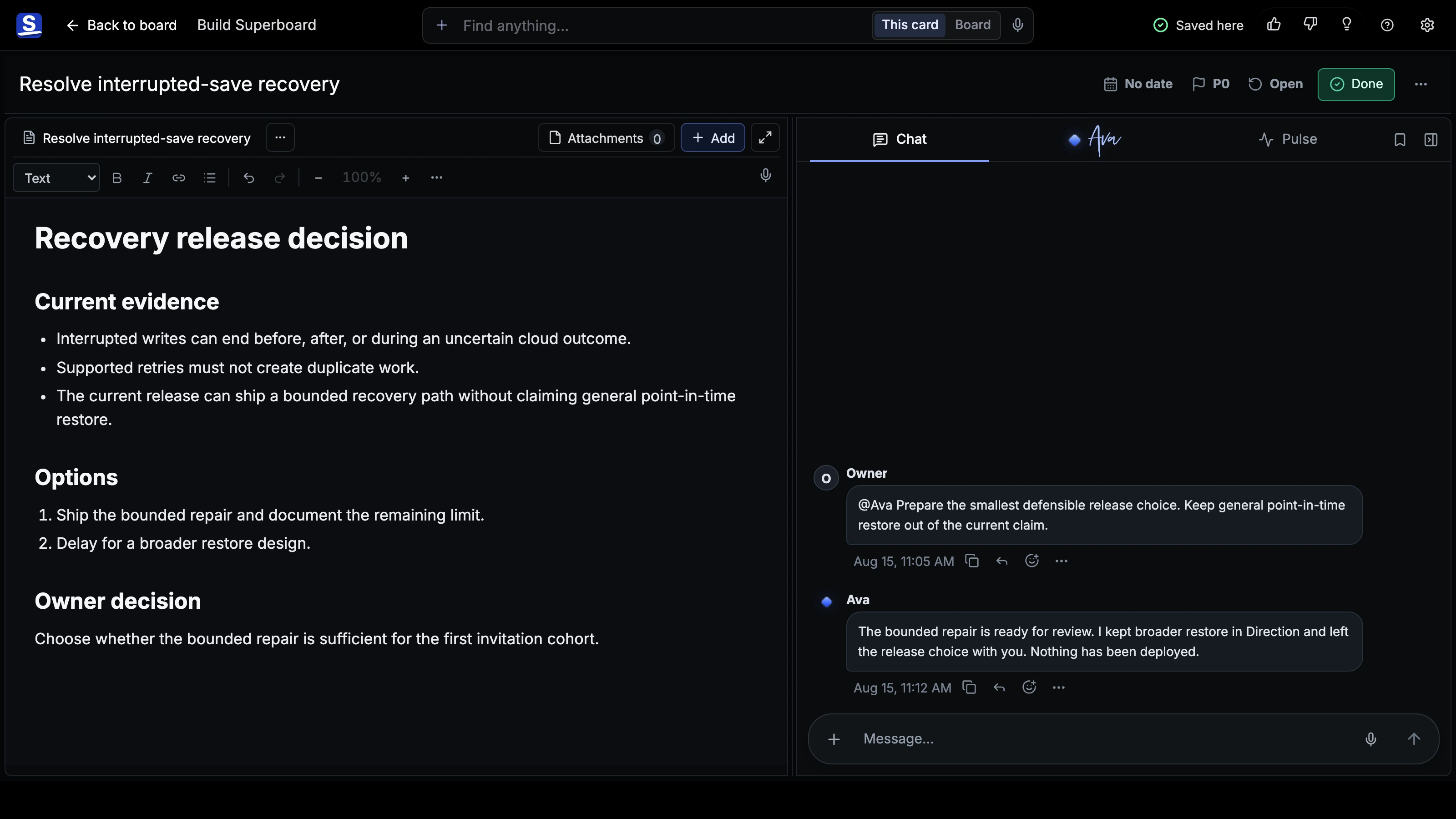
Opening the consequential Card reveals its Room. Stage holds the working Document, Checklist, and File references. Chat preserves the sequential discussion and explicit @Ava requests. Pulse summarizes what matters now; Activity preserves the complete attributed record.
Current Superboard keeps these surfaces together and supports bounded recovery. Current behavior does not include Ava gathering broader evidence, preparing viable options, identifying uncertainty, or recommending the move shown later in this example; that prepared-judgment workflow is Direction.
Direction
Direction: Ava returns prepared judgment
A release candidate has one unresolved tradeoff: ship the simpler recovery behavior now or delay for a broader restore design. The Direction is for Ava to gather the relevant evidence, prepare viable options, identify uncertainty, and recommend a move. The Owner makes the consequential choice and provides any authority needed for an external action; Ava does not decide or authorize that boundary on the Owner’s behalf.
Current Superboard does not automatically coordinate coding environments, deployments, research agents, or production releases from the Board. Any future external action still requires the applicable connection and authority.
What remains with the Owner
The Owner remains responsible for the mission itself, its constraints, every consequential judgment, and the real authority required for an external action. Direction may let Ava or another governed tool execute within an applicable connection and grant, but neither model capability nor a remembered preference creates that authority.
What to do next
Verify the current Board and Room loop, then read where human judgment belongs before evaluating the illustrative Direction. The article-end waitlist action does not grant beta access.
What is current and what is illustrative
The Board, Cards, Rooms, Stage artifacts, Chat, Pulse, Activity, search, saving, and supported recovery shown here are current product surfaces. The fixture contains no customer data and is reproducible.
The deeper cross-work reasoning, continuous monitoring, prepared external workflow, and sending or spending described in the story are illustrative Direction unless a current Help article says otherwise. The Owner remains responsible for the mission, its constraints, every consequential judgment, and real authority throughout both the current example and that Direction.
| Available today | Direction illustrated by the story |
|---|---|
| Board, Lists, Cards, and Card Rooms | Deeper reasoning across the mission by default |
| Documents, Checklists, Files, Chat, Pulse, and Activity | Prepared recommendations using broader evidence |
| Bounded Ava actions and explicit @Ava requests | Governed sending, publishing, purchasing, or external execution |