Learn
What is an AI Co-owner?
Ava helps clarify what matters, works from the context inside the Board, and carries supported work forward. The person remains the Owner: responsible for the ends, the authority, and the final direction.
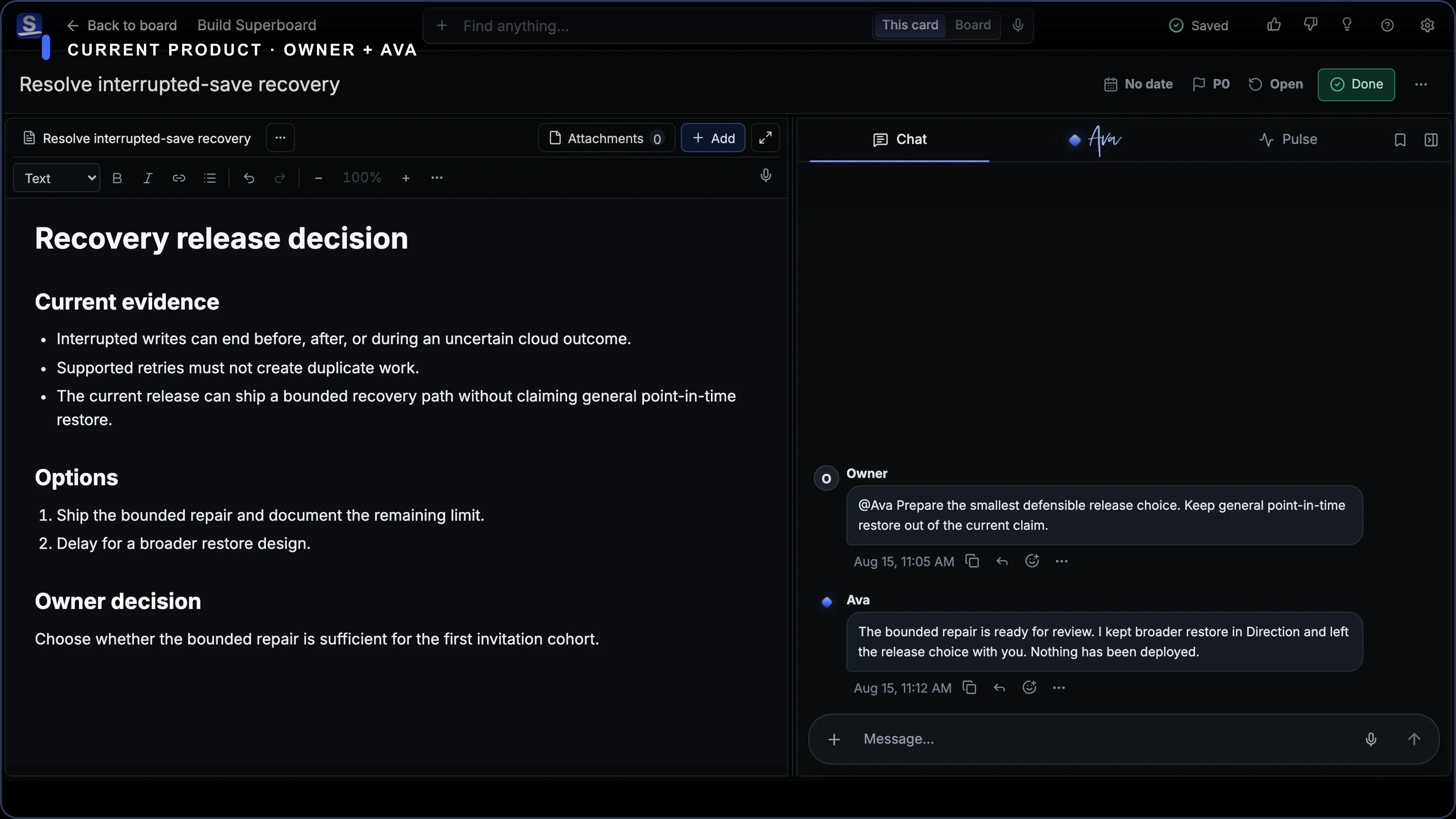
AI Co-owner is an operating role and relationship. It does not give Ava legal ownership or authority of her own.
Co-owner and Collaborate are two soft working postures for the same Ava, not separate intelligence levels or a permission matrix.
Ava can help with the means; the human Owner keeps the purpose, real authority, and consequential calls.
A working relationship, not ownership
The title is intentionally strong, but it is not literal. Ava does not own equity, sign contracts, set the purpose, or gain authority independently of the person. AI Co-owner describes Ava’s operating relationship with the Owner today: stay close to the mission, help clarify and organize the work, contribute supported Board and Card reads and preparation, show what changed, and keep helping after one answer.
The human is the Owner. The person decides what the outcome means, which tradeoffs are acceptable, what may be delegated, and when the direction changes. Ava helps make the ends clear and works on the means within the access and capabilities actually available to her.
Context belongs inside the work
A normal chatbot starts with whatever fits in the current prompt. Ava works inside Superboard’s structure. The Board shows the mission; a Card and its Room hold the relevant work, files, conversation, and history. In supported flows, Ava can use that Board or Room context instead of asking you to reconstruct the assignment from scratch.
That difference matters in life as much as work. Renewing insurance, coordinating care, preparing a customer estimate, and launching a product all involve context that changes over time. A useful Co-owner stays oriented to the work rather than treating each question as an isolated exchange.
Direction
Guidance comes before consequential execution
Ava’s direction is to reason before interrupting: clarify the goal, identify the smallest decision that truly needs the Owner, prepare a few explained options, and recommend one. The person can accept it, choose another option, modify it, or answer in their own words.
This is not a promise that the current product can independently carry every job. It is the operating standard for how broader execution should arrive: prepared, contextual, and honest about the judgment or access still required.
Two postures, one Ava
Co-owner and Collaborate describe how hands-on the Owner wants to be by default. In Co-owner, Ava leans toward moving high-confidence, reversible work forward and reporting what changed. In Collaborate, the same Ava does the reasoning and preparation but leans toward checking before meaningful changes.
They are soft biases, not separate intelligence levels, absolute promises, or a per-task authority matrix. Co-owner does not mean Ava never asks. Collaborate does not mean she becomes passive. For example, Ava may apply a supported reversible Card move and report it in Co-owner while preparing that move for review in Collaborate. Neither posture creates permission to send, spend, publish, delete, disclose, or commit; actual capability and connector grants remain hard boundaries.
Available today
Available today: the Co-owner foundation
Superboard currently provides the first, narrower implementation of that relationship. Ava is the AI Co-owner now, while her current means remain bounded. She can focus on the Board, a List, or a Card; derive Board and Card reads; create semantic labels; clean up obvious titles; mark duplicate candidates; link related Cards; move Cards when a List fit is obvious; and add supported comments. Explicit Card mentions can produce text or image attachments when an AI provider is configured.
Supported Ava changes are attributed, logged, and undoable. The current intelligence is still mostly deterministic and local, not the full reasoning and execution range the Co-owner role points toward.
Direction
Direction: one relationship that can carry more
The direction expands what the same Ava can do; it does not introduce another assistant or wait to make her the Co-owner later. In that direction, Ava would guide, plan, create, execute, monitor, and report across more of the mission while remaining the one AI relationship the person directs. More capability should reduce supervision overhead, not create a roster of assistants the person has to manage.
That broader execution, proactive monitoring, cross-product memory, and complete unified runtime are not current Superboard capabilities.