Learn
Authority, memory, and autonomy are different systems
Good AI delegation depends on three separate questions: what Ava knows, how readily she moves supported work, and what she is actually allowed to do. Collapsing those questions creates either needless prompts or false confidence.
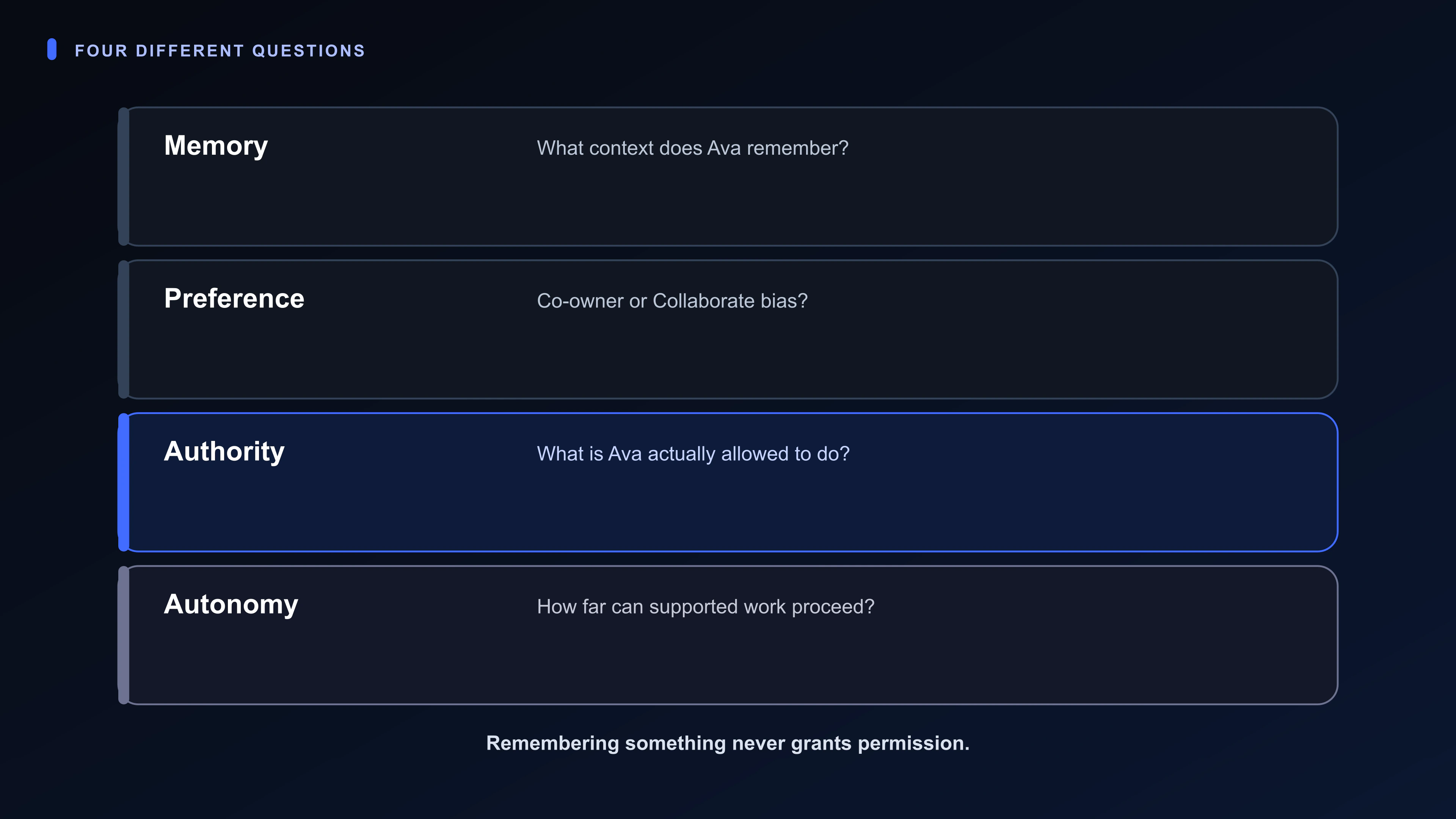
Memory improves context; it never creates permission.
The Owner keeps the ends and consequential judgment; capabilities, connections, credentials, and grants remain hard boundaries.
Direction: Ava carries more preparation and execution without turning preference or memory into permission.
Three questions, three answers
| System | Question it answers | What it cannot do |
|---|---|---|
| Memory and context | What does Ava know that is relevant? | Grant permission |
| Autonomy posture | How readily should Ava move supported work? | Create a connector or capability |
| Authority | What action is allowed with which resource? | Decide the Owner's ends |
A preference is useful context, not consent
Remembering that you usually prefer the fastest shipping option may help Ava prepare a recommendation. It does not authorize a purchase. Remembering a concise writing style may improve a draft. It does not authorize sending the message.
This separation matters most when the action leaves Superboard, affects money, reaches another person, exposes private data, or becomes hard to reverse.
Available today
Available today: bounded work and visible recovery
Current Superboard gives one signed-in Owner Board and Card context, Co-owner and Collaborate postures, bounded Ava actions, attribution, Activity, and supported Undo. The customer-facing Card mention is @Ava.
Current Superboard does not provide a unified personal Memory Spine, broad external execution, or a permission system that can be inferred from remembered preferences.
Direction
Direction: stronger delegation without a control cockpit
Direction—not available today—is for Ava to carry more preparation and execution while keeping real grants enforceable and returning consequential judgment to the Owner. It is not a growing matrix that makes the person administer every task.
More capable models should reduce supervision overhead without hiding what happened, who acted, which source supported the action, or how recovery works.