Example
How a solo product founder runs the whole product in Superboard
A solo founder has to hold customer truth, product judgment, implementation, launch work, and support at the same time. One Board makes the tradeoffs visible without pretending Ava already runs the company.
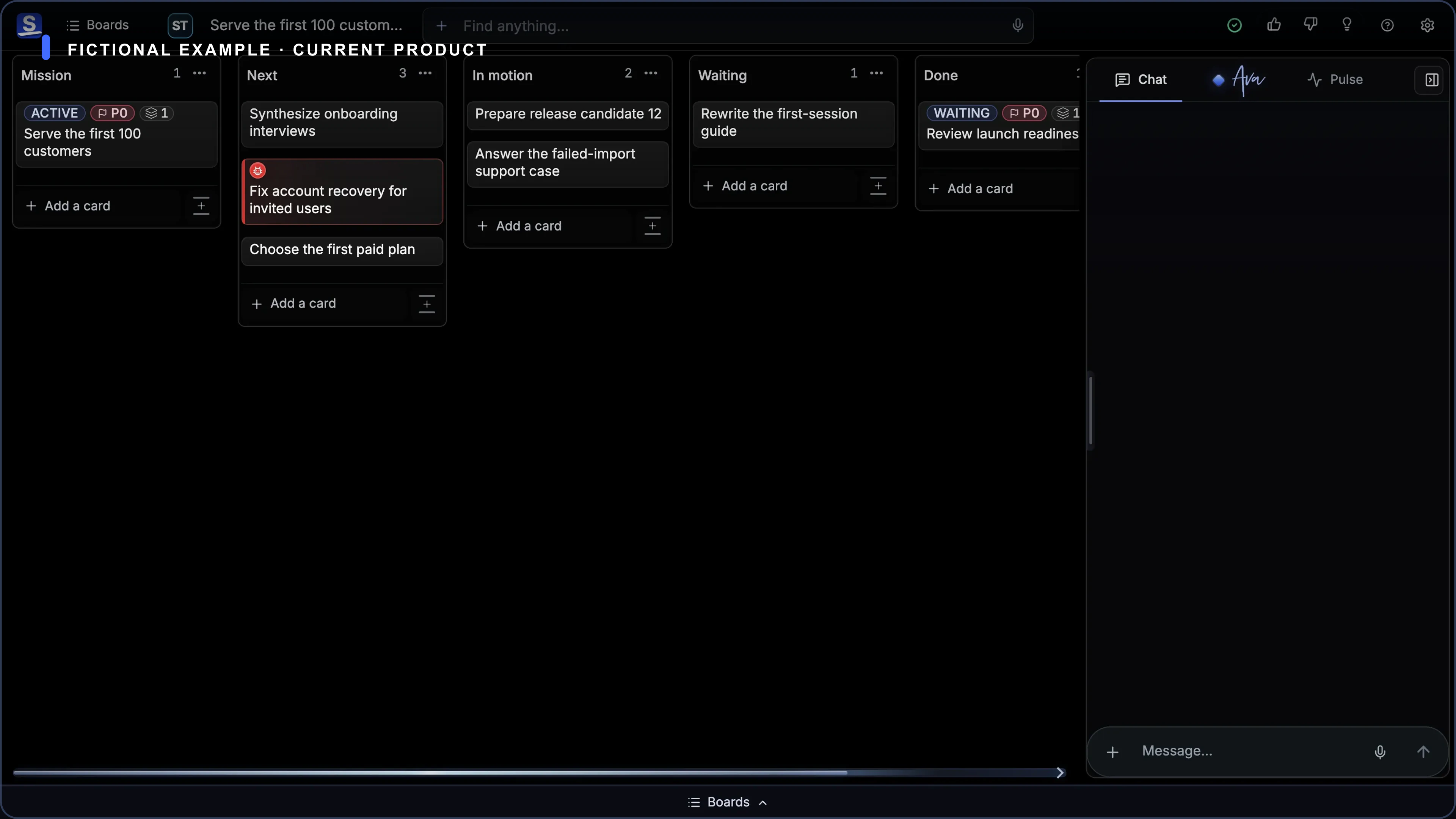
One Board makes the mission visible as one operating picture: find and serve the first hundred people who depend on the product.
Customer evidence, release work, defects, and decisions can each be a Card; the consequential release Card opens into a Room with the working brief and history.
The Founder keeps the product mission, constraints, consequential judgment, and real authority; Direction may let governed tools execute within a grant, but Ava cannot create or authorize that grant herself.
The point and the current boundary
A solo founder can hold customer truth, product judgment, implementation, launch work, and support on one Board so the first-hundred-customers tradeoffs stay visible without pretending Ava already runs the company.
Current behavior is the Board, flexible Cards, Card Rooms, Stage, Chat, Pulse, Activity, search, saving, supported recovery, bounded Ava actions, and explicit @Ava requests in Card Chat. Ava does not currently interview customers, deploy the product autonomously, or create her own authority; those exclusions do not mean Ava has no bounded current role.
Available today
Available today: one Board for the mission
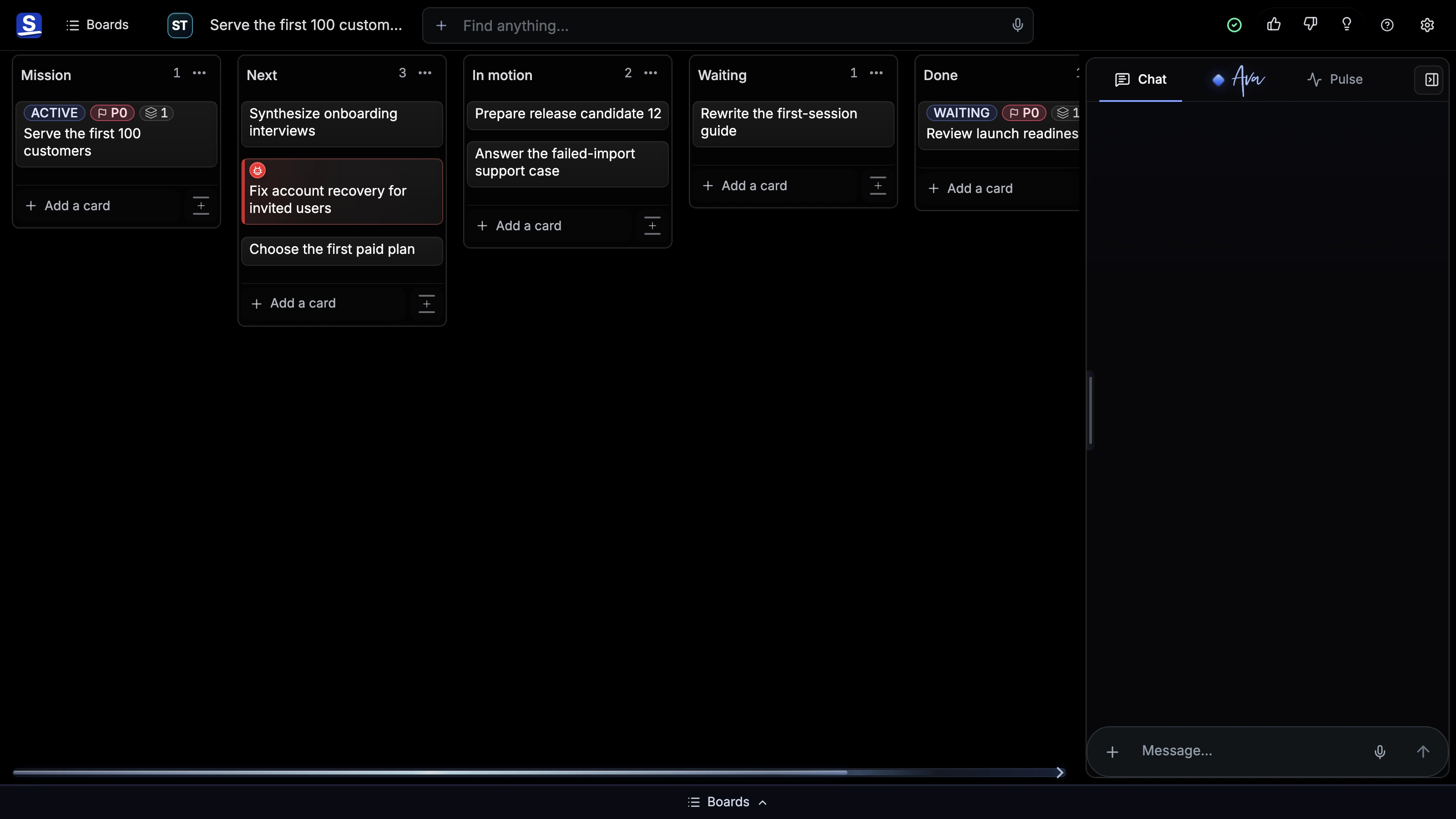
The mission is to find and serve the first hundred people who depend on the product. The deterministic example uses Lists for Mission, Next, In motion, Waiting, and Done so the current front remains scannable.
Cards hold a customer interview synthesis, onboarding defect, release checklist, pricing decision, support issue, and launch asset. Current Superboard can hold these different forms of work without forcing them into one task-only schema.
Available today
Available today: the Room keeps the work and reasoning together
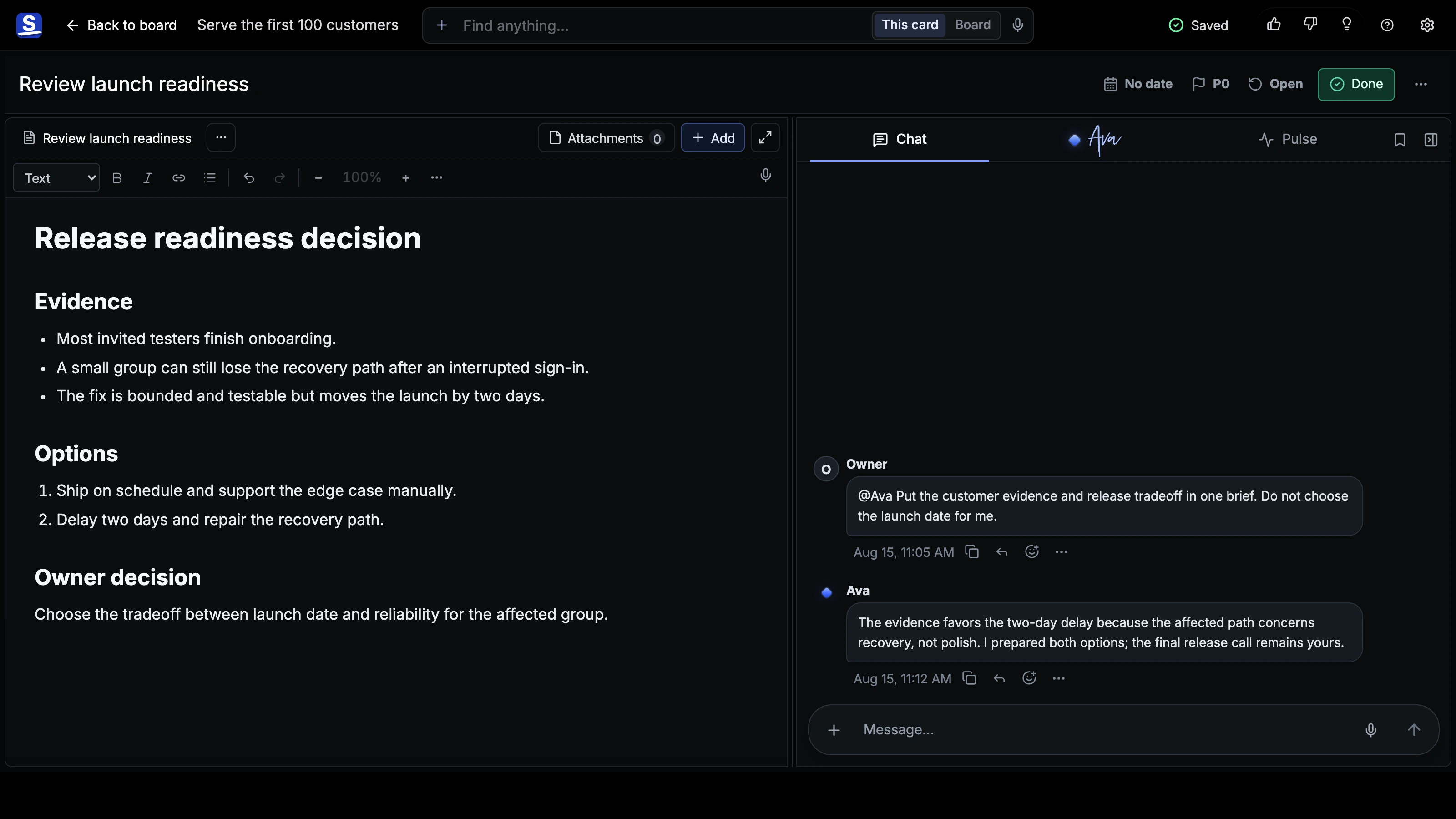
Opening the consequential Card reveals its Room. Stage holds the working Document, Checklist, and File references. Chat preserves the sequential discussion and explicit @Ava requests. Pulse summarizes what matters now; Activity preserves the complete attributed record.
Current Superboard keeps these surfaces together and supports bounded recovery. Current behavior does not include Ava gathering broader evidence, preparing viable options, identifying uncertainty, or recommending the move shown later in this example; that prepared-judgment workflow is Direction.
Direction
Direction: Ava returns prepared judgment
The Founder must choose whether to delay the release for a reliability fix that affects a small but important group. The Direction is for Ava to gather the relevant evidence, prepare viable options, identify uncertainty, and recommend a move. The Owner makes the consequential choice and provides any authority needed for an external action; Ava does not decide or authorize that boundary on the Owner’s behalf.
Current Superboard neither interviews customers nor deploys the product autonomously. Any future external action still requires the applicable connection and authority.
What remains with the Owner
The Founder keeps the product mission and its constraints, makes every consequential judgment—including which customer problem matters, what quality bar the release must clear, which tradeoff is acceptable, and whether to ship—and holds real authority. Direction may let governed tools prepare or execute supported steps, but neither model capability nor remembered preference creates deployment, publishing, spending, or customer authority.
What to do next
Verify the current Board and Room loop first, then read the human-judgment boundary before evaluating the illustrative release workflow. The article-end waitlist action is appropriate only if today's solo product fits a real mission.
What is current and what is illustrative
The Board, Cards, Rooms, Stage artifacts, Chat, Pulse, Activity, search, saving, and supported recovery shown here are current product surfaces. The fixture contains no customer data and is reproducible.
The deeper cross-work reasoning, continuous monitoring, prepared external workflow, and sending or spending described in the story are illustrative Direction unless a current Help article says otherwise. The Owner remains responsible for the mission, its constraints, every consequential judgment, and real authority throughout both the current example and that Direction.
| Available today | Direction illustrated by the story |
|---|---|
| Board, Lists, Cards, and Card Rooms | Deeper reasoning across the mission by default |
| Documents, Checklists, Files, Chat, Pulse, and Activity | Prepared recommendations using broader evidence |
| Bounded Ava actions and explicit @Ava requests | Governed sending, publishing, purchasing, or external execution |