Example
How Al keeps his lawn-care business clear in Superboard
Al has customers to serve, estimates to price, routes to plan, equipment to maintain, and growth work that cannot disappear behind today’s jobs. One Board shows the business; each Card opens a Room that keeps the artifact, the conversation, the state, and the record together.
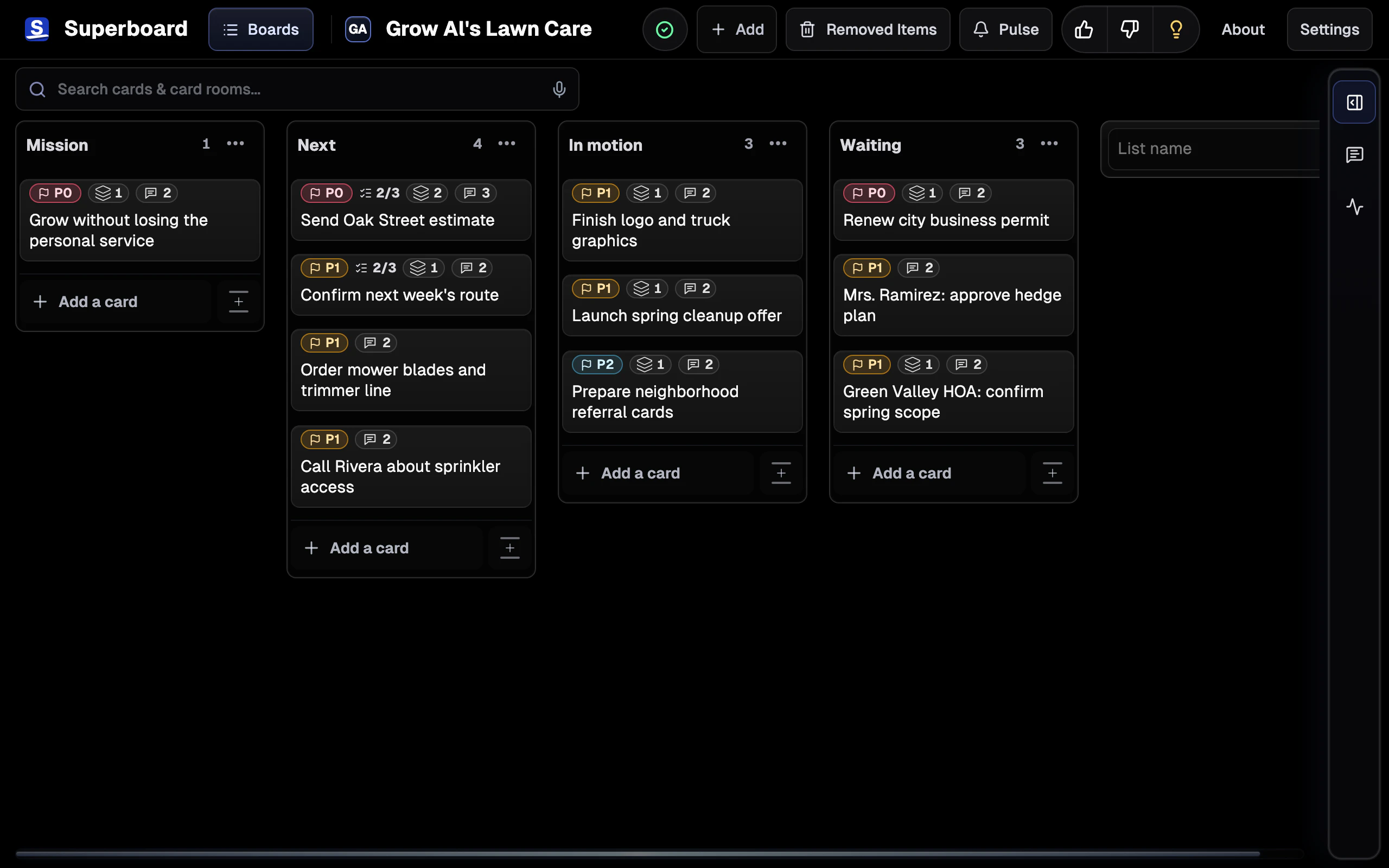
One Board lets Al scan the mission, upcoming work, active work, and decisions waiting on him.
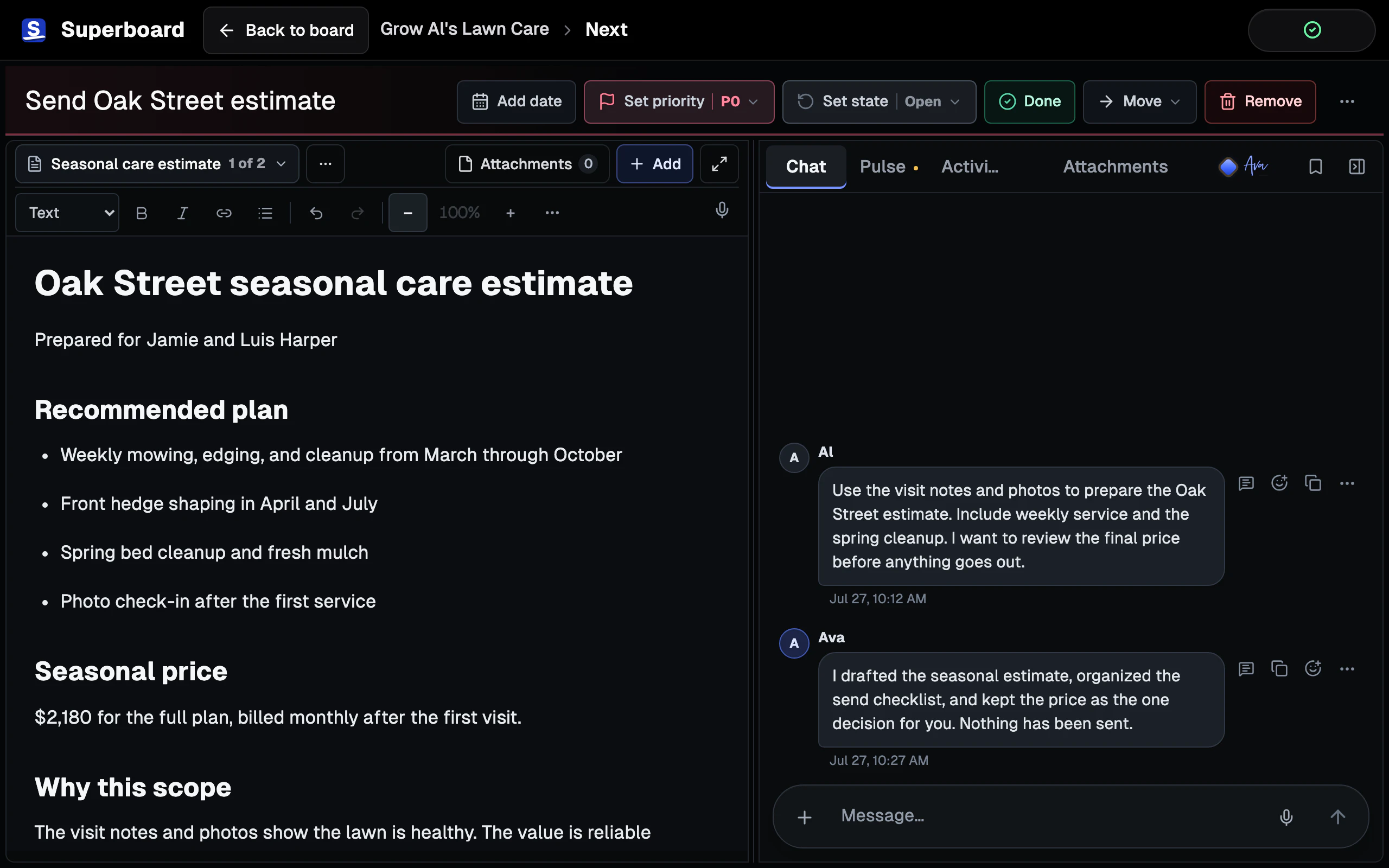
Each meaningful Card opens into a Room where the artifact, Chat, Pulse, Activity, and recovery stay with the work.
The interface shown is current; the full story of Ava preparing estimates, campaigns, and routes is explicitly illustrative Direction.
Available today
Available today: one Board for the business
The fictional business has one mission: grow Al’s Lawn Care without losing the personal service that earns referrals. Lists for Mission, Next, In motion, Waiting, and Done make the operating picture scannable.
The Cards are not all tasks. One is the mission. Others are an estimate, a route decision, a spring offer, equipment, a permit, and customer follow-up. Current Superboard can hold those different parts of the business, their dates and optional priority, their artifacts and conversation, and their Activity.
Available today
Available today: the Card becomes the work’s home
Opening Send Oak Street estimate turns the Card into a Room. The Card is named for the job Al wants to finish; Superboard does not currently send the estimate. Its Stage can hold the seasonal estimate, a Checklist, and File references. Chat keeps the conversation beside the artifact. Pulse summarizes the current state and work needing attention. Activity preserves who changed what.
Those Room surfaces and supported Undo and recovery paths are available today. The polished sequence shown in the fictional story—Ava gathering the evidence, drafting the scope, and isolating the price decision—is Direction.
That is why the Card—not a detached chat or a list row—is the home. Al can return to the artifact, the talk, the current state, and the attributable history in the same place. It is one Ava working across many Rooms, not a new assistant for every job.
Direction
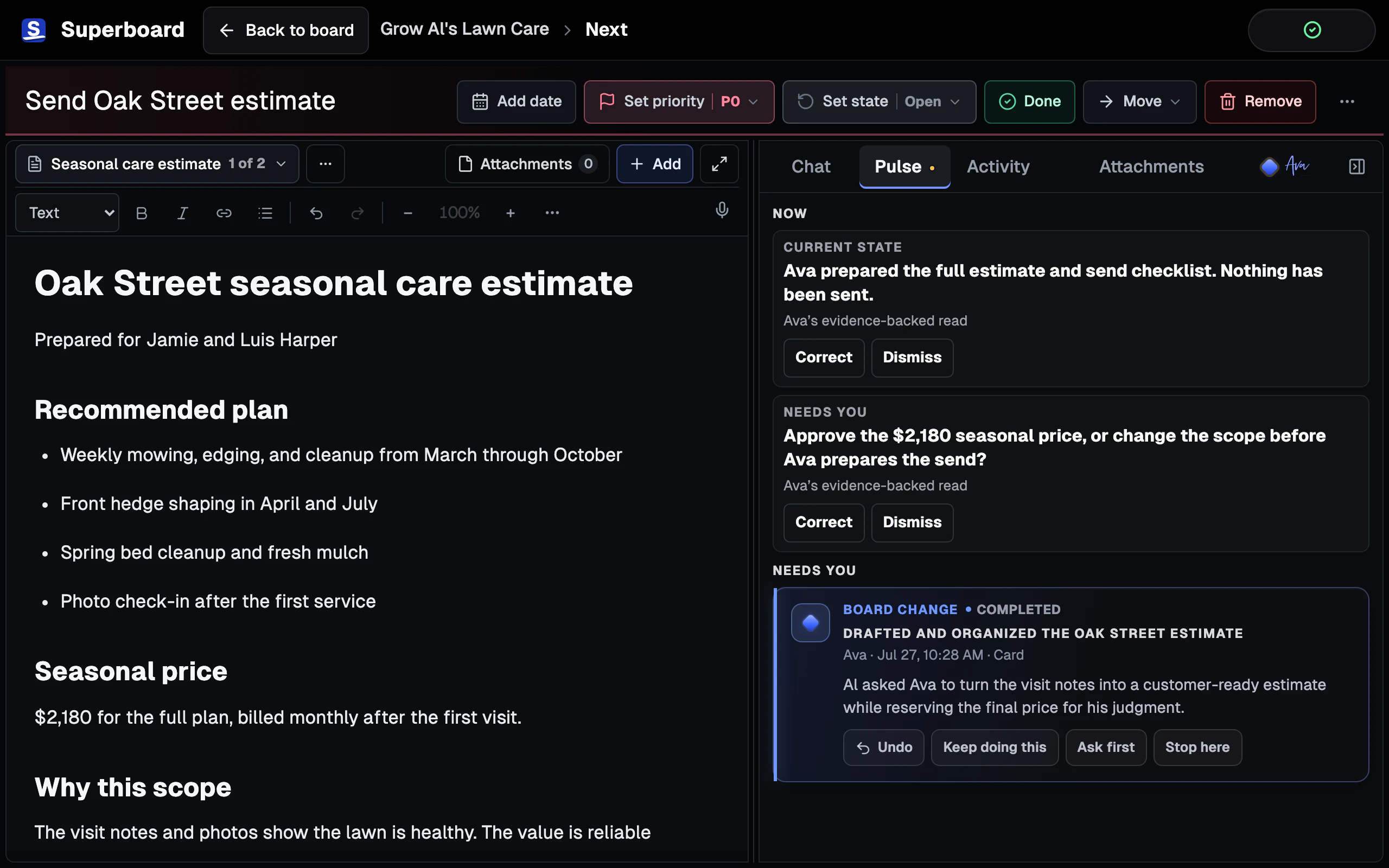
Direction: Oak Street becomes prepared judgment
The example’s fuller Ava workflow is Direction. Ava gathers the visit notes and photographs, drafts the scope and send checklist, and returns one consequential choice: approve the $2,180 seasonal price or change the scope. The preparation is already visible; Al is not handed a blank question.
Current Superboard neither runs that full sequence autonomously nor sends the estimate. Any future send still needs the applicable connection and grant; the customer promise stays with Al.
Direction
Direction: spring cleanup offer
A separate Room can keep the offer brief, draft copy, visual exploration, and launch checklist together. In the illustrative workflow, Ava compares a discounted early-booking offer with a full-price spring cleanup package and recommends the one that protects the schedule and margin. Al decides whether either promise fits the customers he knows—and rejects a discount if rain delays would make the timing dishonest.
Superboard can hold the current artifacts and conversation today. It does not currently publish the campaign or execute an external marketing workflow. Those actions remain Direction and would require the applicable connection and grant.
Direction
Direction: route planning without false confidence
The route Card gives next week’s plan a durable home. Its Room can keep customer and service inputs, equipment constraints, a Checklist, and the resulting decision together.
In the illustrative workflow, Ava prepares a route recommendation but flags that one side gate opens only after 10 a.m. and another stop needs trailer access. Al decides whether to move the stops or call the customers. Current Superboard does not map the route, monitor traffic, or coordinate those external systems on his behalf.
What is current and what is illustrative
Al, the customers, and every business detail shown here are fictional. The example is reproducibly generated and captured from the current interface on desktop and mobile. No customer data appears in it.
Available today are the Board, Cards and Rooms, Stage work, Documents, Checklists, File references, Chat, Pulse, Activity, search, saving, and supported recovery shown or described here. Ava’s current foundation can make limited reversible Board changes and can produce a model-backed response to an explicit Card mention when live AI is configured.
Direction is the deeper end-to-end reasoning in the story: gathering evidence across the work by default, preparing a customer-ready estimate, developing campaign choices, recommending a route, and executing through external systems. The screenshots illustrate the intended Co-owner loop; they do not claim those future behaviors are already autonomous or live.
| Available today | Direction illustrated by the story |
|---|---|
| Board, Lists, Cards, and full Card Rooms | Deeper reasoning across the business by default |
| Documents, Checklists, Files, Chat, Pulse, and Activity | Prepared estimate, campaign, and route recommendations |
| Limited reversible Ava actions and explicit Card mentions | Governed sending, publishing, mapping, and other external execution |