Compare
Superboard vs. Trello: from visual cards to a mission home
Trello makes shared visual card tracking approachable and mature. Superboard keeps that scannable Board starting point, then gives each Card a Room where the work, conversation, attention, history, and Ava stay attached.
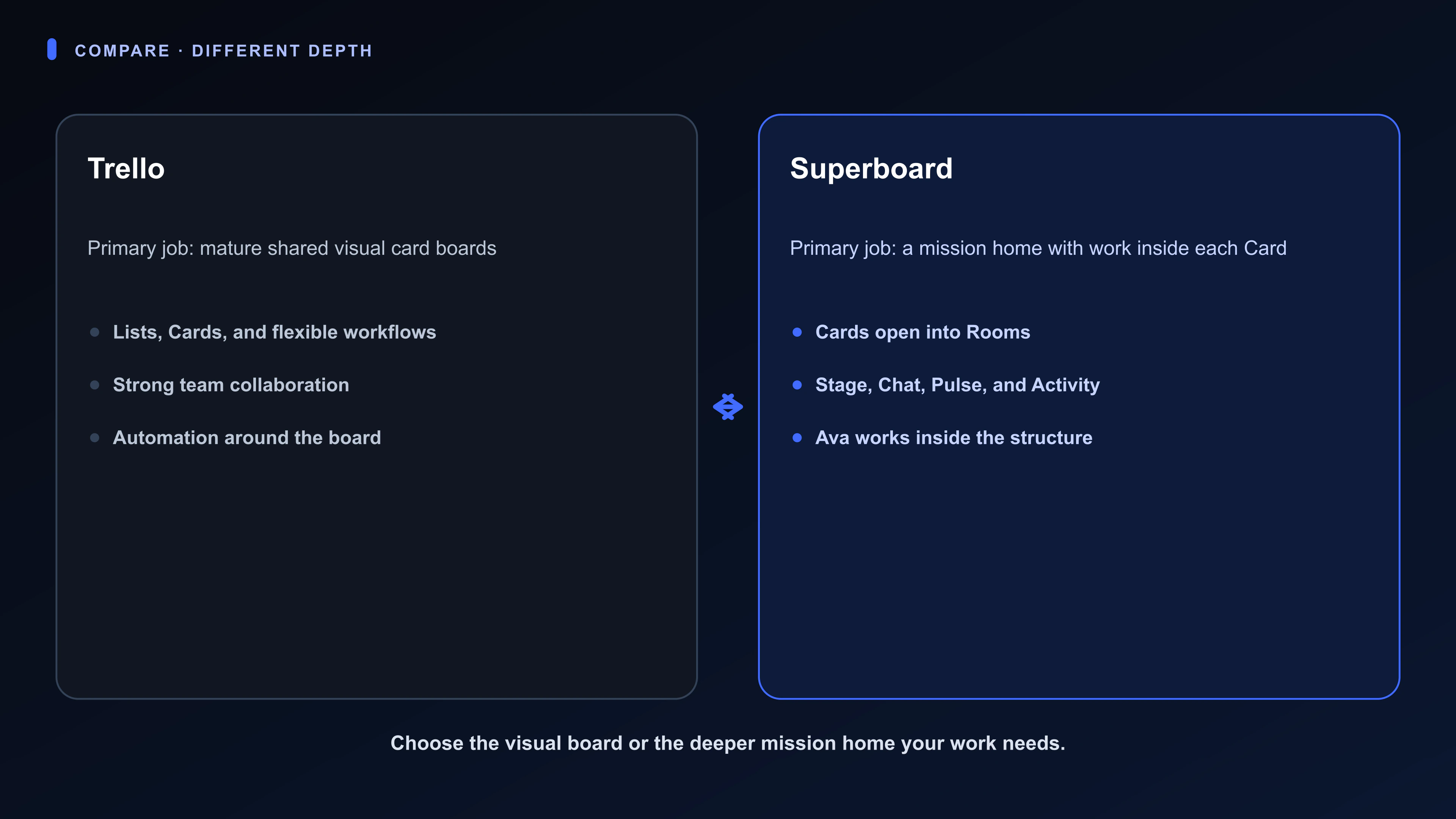
Stay with Trello when a mature shared card board, permissions, views, Power-Ups, and automation are the job.
Try Superboard when one Owner needs the plan and the work itself to live together, not only a card that points elsewhere.
Superboard can import a Trello Board, but the migration has explicit preservation and attachment limits.
The familiar starting point—and the category divergence
| Dimension | Trello | Superboard |
|---|---|---|
| Map | Boards organize Lists and Cards | List-based Boards; each Card opens a Room with Stage, Chat, Pulse, and Activity |
| Inside a Card | Description, comments, checklists, attachments, fields, dates, members, and activity | A Room with ordered Stage, sequential Chat, focused Pulse, and Activity |
| Work artifacts | Attachments, descriptions, checklists, and Power-Ups | Documents, native Checklists, and File references coexist in Stage |
| Views and extensibility | Table, Calendar, Timeline, and other eligible-plan views; Power-Ups and integrations | One list-based Board view today; richer views and additional Stage runtimes are Direction |
| Automation and AI | Rules, buttons, schedules, due-date automation, and AI features | Ava works inside Board/Card context; broader reasoning and execution remain Direction |
| Collaboration | Mature shared Boards, permissions, members, comments, and notifications | Solo-first; realtime small-team collaboration is Next |
| Recovery | Archived Cards and Lists can return to a Board; eligible admins can reopen closed Boards; permanent deletion cannot be undone | Supported Undo, Removed Items, and certain preserved conflict copies; general point-in-time restore is Direction |
What Trello does especially well
Trello has spent years making the Board, List, and Card model flexible and legible. Teams can collaborate on shared Boards, manage visibility and members, filter work, add fields and Power-Ups, and use alternate views on eligible plans.
Its automation is also mature. Trello documents rules, card and Board buttons, scheduled runs, and due-date triggers, with logs and plan-based quotas. If the central need is shared visual tracking with an established ecosystem, Trello is the safer choice today.
A Card and a Room are not the same thing
Both products use Boards, Lists, and Cards, but the nouns carry different weight. In Trello, the Card is the detailed unit inside the board. In Superboard, a Card opens into a Room intended to hold the actual work and its operating context together—whether that work is a customer estimate, a move, or an insurance renewal.
Stage keeps ordered Documents, native Checklists, and File references. Chat keeps the sequential conversation. Pulse separates current state, Owner attention, and recent meaningful changes from Activity, the attributed chronological record. Ava works from that structure instead of living in a detached chatbot window.
Available today
Available today: where Superboard is narrower
Superboard is built for one signed-in Owner today. It has no realtime multiplayer, team roster, organizations, or Trello-scale ecosystem. Its Board layout is list-based only, and its Ava foundation is mostly deterministic and local rather than a complete agentic execution system.
Superboard does have a real daily-driver loop, multiple cloud Boards, Card Rooms, Stage artifacts, Chat, Pulse, Activity, lexical search, supported Undo, Removed Items, and preserved copies for certain interrupted or conflicted writes. The difference is not that Superboard has every Trello feature plus AI. It is that Superboard makes the mission home and the work-in-place the primary product bet.
Moving a Trello Board into Superboard
Superboard's guided importer accepts a Trello JSON export, validates it, previews what will be preserved, and creates a new cloud Board. Open Trello Lists and Cards become active Superboard Lists and Cards. Card titles become native titles. Descriptions become the first imported comment and remain in import metadata; Trello comments remain ordered by their Trello activity date.
Labels, member references, due dates, checklists, source URLs, original List context, archived state, and raw source IDs stay in import metadata by default; they do not create collaborators, permissions, or native Stage Checklists. Ava may later map imported labels into the Board's semantic labels, but import itself does not perform that conversion. Archived Cards and Cards from archived Lists go to Removed Items with their source context.
Attachment records keep their Card linkage, available name and source metadata, original URL when Trello provides one, and copy status. File bytes copy in the background only when Superboard storage is configured, the source remains accessible, and the file passes current limits. Private, expired, missing, oversized, failed, or timed-out files may remain as an original link or metadata-only record; no byte copy is guaranteed.
When to stay, switch, or use both
Trello and Superboard are separate products and are not affiliated.
- Stay with Trello when mature team collaboration, established automations, views, and Power-Ups matter more than native work Rooms.
- Try Superboard when one Owner needs an important part of life or work to keep artifacts, conversation, decisions, and Ava with the map.
- Use both during evaluation: keep Trello as the established team system while testing whether one mission benefits from Superboard's deeper Card Room.
- Do not migrate until the import preview and current Superboard limits are acceptable for the Board that matters.
Official sources
Material claims about the other product were checked against these first-party sources on 2026-08-14.