Learn
How Ava’s Memory Spine and Board context fit together
One Ava should be able to know a person without flattening every mission into one giant prompt. The direction separates durable person context from canonical Board state, current conversation, and external evidence, then retrieves only what the present need justifies.
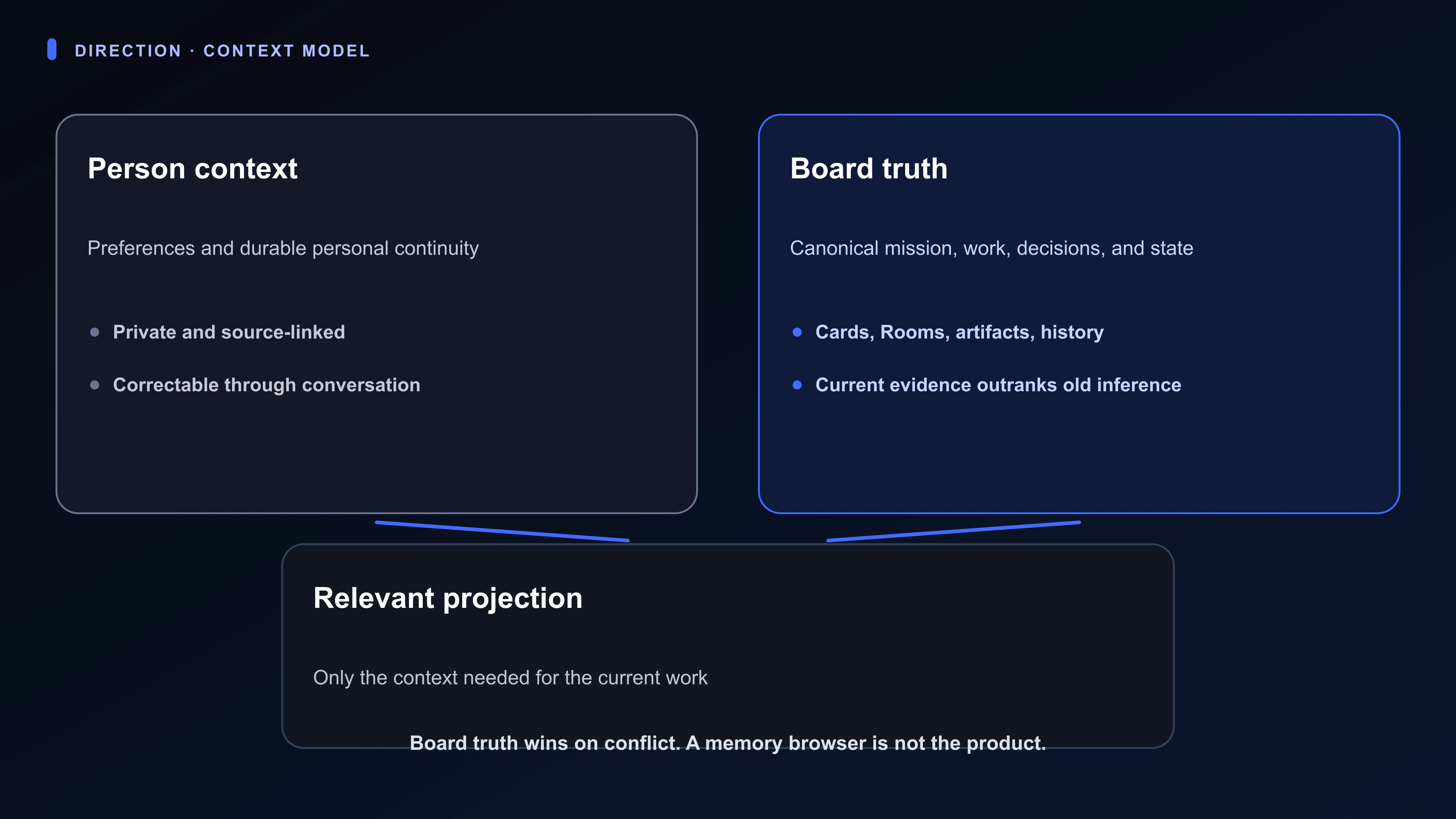
The Memory Spine is durable person context; the Board is canonical mission truth; conversation and external evidence answer narrower questions.
A bounded working projection should carry scope, provenance, uncertainty, and correction rather than dump an entire account into every turn.
Superboard’s sibling life product, You.one, has a memory implementation foundation; Superboard does not consume it in production today.
Knowing the person is not the same as loading every Board
Ava may need to know that someone prefers direct recommendations, is coordinating care for a parent, or will not trade a customer promise for a faster route. That is person context. She may also need the current estimate, the Cards waiting on a decision, or the latest change to a launch specification. That is mission context.
Mix everything into one undifferentiated memory and two problems appear. Irrelevant private context leaks into work that does not need it, and the model receives more material without gaining more truth. Useful continuity requires boundaries as much as recall.
Four sources have four jobs
| Source | Job | Example |
|---|---|---|
| Memory Spine | Durable person context: preferences, relationships, patterns, commitments, and corrections | Prefers a recommendation with the tradeoff stated plainly |
| Board context | Canonical mission state: Cards, artifacts, decisions, history, and current work | Oak Street estimate is waiting on a scope decision |
| Current conversation | What the person is asking and correcting now | Keep the patio out of this version |
| External evidence | Fresh facts from an authorized source | A current vendor quote or policy document |
Direction
The working projection should be bounded
Ava should retrieve only the fragments the present need justifies—for example a relevant goal or constraint, a Board slice, a short passage, or a piece of evidence. Ava should not receive every Card in a large account or every remembered detail on every turn.
The projection needs scope and provenance. Ava should be able to distinguish what the person said, what the Board records, what an external source says, and what Ava inferred. Uncertainty should remain visible instead of being promoted into a durable fact. When sources disagree, Board truth stays canonical for the mission; person memory does not overwrite Cards, decisions, or artifacts.
Direction
Correction needs one semantic writer
A durable person model becomes untrustworthy if every feature and worker can rewrite it independently. The direction uses one semantic memory writer to synthesize evidence, version meaning, preserve provenance, and apply correction consistently.
That does not mean one database row or one model call. It means one governed path decides what becomes durable person understanding. Board state continues to change through Board and Card paths, not through the person-memory writer. Other systems can propose evidence; they do not silently create competing versions of the person. In-turn corrections can shape the working projection immediately without automatically becoming durable person memory.
Preference is not permission
Remembering that someone likes early appointments can improve a recommendation. It does not authorize Ava to book one. Knowing a normal budget can help compare options. It does not authorize spending. Remembering a writing style can shape a draft. It does not authorize sending it.
Memory supplies context. Authority comes from explicit grants, current scope, and enforced product boundaries. Relevance never becomes permission merely because Ava is confident.
Available today
What exists today—and the You.one boundary
Superboard today can read the active Board and Card context needed for supported Ava features. It can derive Board and Card insights, use indexed lexical search, and work with the current Room and its artifacts. There is no Superboard customer-facing Memory Spine, memory browser, or account-wide semantic person retrieval today.
Superboard’s sibling life product, You.one, has an implementation foundation for one semantic writer, retrieval, person-memory projection, and mutation. Superboard production does not currently consume that writer, its tables, or its retrieval path. Sharing that foundation safely is Direction, not a present-tense capability.
Direction
Direction: one Ava, the right context, no giant prompt
The goal is not perfect recall. It is one Ava who retrieves the right person context and the right mission truth for the turn, shows the sources that shaped a recommendation when the product surface supports it, accepts correction, and leaves unrelated private context outside the working set.
That architecture lets continuity grow without collapsing every Board, relationship, and piece of evidence into one surface. It also keeps the person’s agency intact: what Ava remembers can be corrected, what she infers can remain uncertain, and what she knows still does not decide what she may do.