Learn
Guide and Board are two modes of one Superboard
Some people need a conversation that helps them get clear. Others need the map. The product direction serves both without making the Board a prerequisite or turning Guide into a separate application.
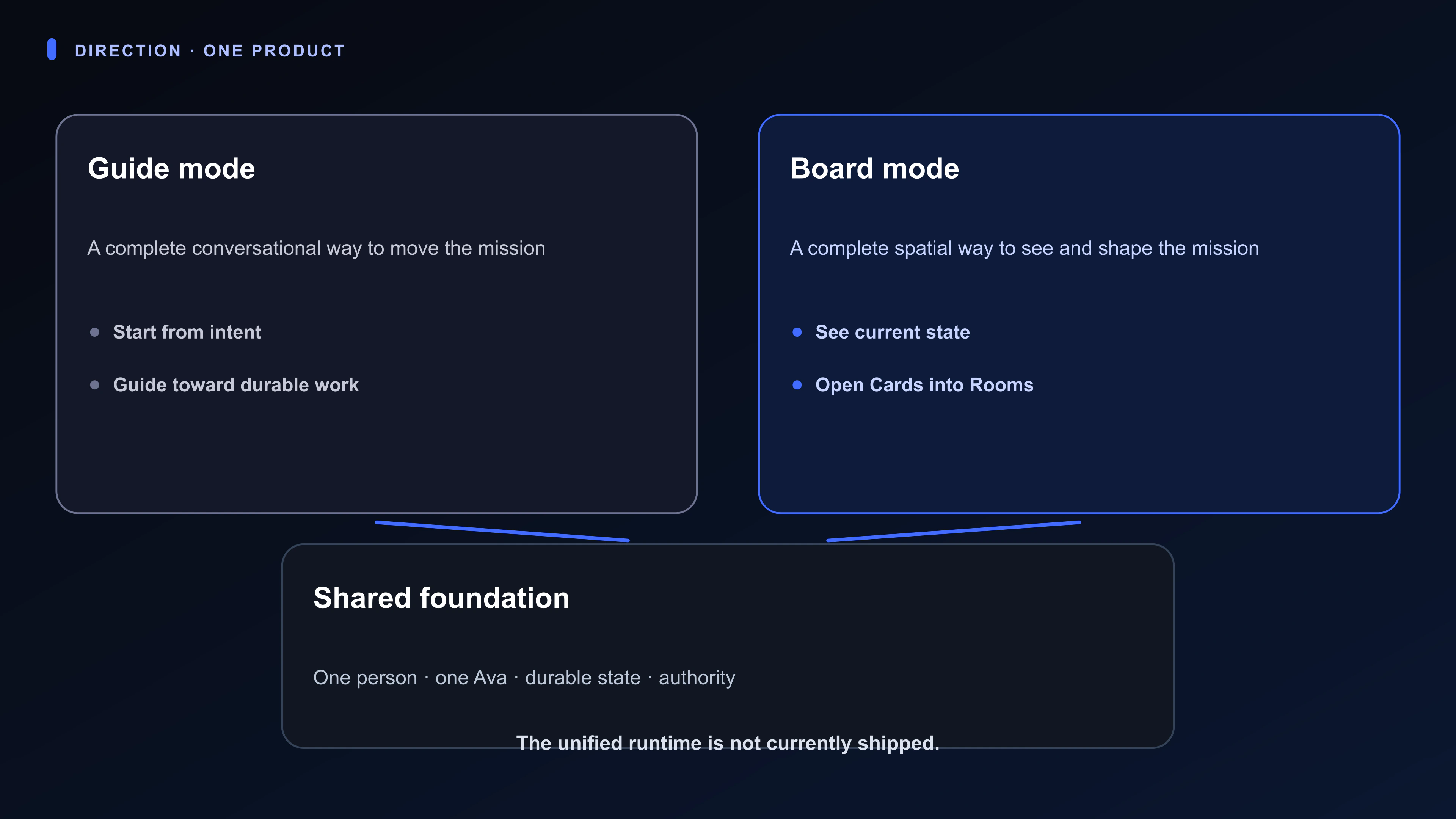
Direction—not available today: Guide is complete, not a funnel, while Board reveals optional depth into the same durable state.
Available today is Board-first; the unified Guide/Board production runtime is not currently shipped.
The Owner runs the current Board structure and keeps the commitments, consequential decisions, and authority.
Direction
The central idea: two modes, one Superboard
Guide and Board are intended to be two complete modes of one Superboard: Guide offers conversational guidance, while Board offers an optional visual map into the same person, Ava, authority, and durable work. Guide is not a simpler entry point that funnels everyone into Board. This unified experience is Direction and is not available today.
Direction
Two experiences, one continuity
Guide mode begins with paths, choices, useful defaults, recommendation cards, voice, and room for a messy dump. Board mode reveals Boards, Cards, Rooms, Stage, Chat, Pulse, Activity, search, and multi-thread visibility.
The destination is one person, one Ava, one Memory Spine, one authority model, and one durable state beneath both modes.
The Board is optional depth, not optional truth
A person should be able to complete useful outcomes through guidance without becoming a kanban administrator. The resulting commitment, artifact, or decision still needs durable identity and a way to return.
When the map becomes useful, opening Board mode should reveal the same work rather than create a second copy.
Available today
Available today: the Board-first foundation
Current Superboard is Board-first. One signed-in Owner can create and switch Boards, work in Card Rooms, use Stage and Chat, see Pulse and Activity, search, and direct Ava with @Ava. The current Ava foundation remains bounded and mostly deterministic/local.
The complete guided experience, direct mode switch, shared Memory Spine, and unified runtime are not available today.
What remains with the Owner
Today, the signed-in Owner creates and switches Boards, works in Card Rooms, uses Stage and Chat, reads Pulse and Activity, searches, and directs Ava with @Ava. Across the product Direction, the Owner still owns the mission, commitments, consequential decisions, and real authority; choosing Guide mode should remove interface overhead, not transfer that responsibility.
Why the distinction matters
Calling Guide a lightweight front door would make people who prefer conversation feel like incomplete customers. Calling Board a separate product would fracture continuity. One product can offer different depths without ranking the people who choose them.